1. OLED (Organic Light Emitting Diode)

OLED panels feature self-emissive organic subpixels. Unlike LED/LCD screens that require a backlight behind the panel, every single pixel on an OLED screen creates its own light and can turn off completely.
- Pros: Infinite contrast ratio, pitch black darkness, widest viewing angles, 0.1ms pixel response time.
- Cons: Lower overall sustained full-screen brightness compared to Mini-LED; potential risk of static image retention if driven at 100% brightness continuously.
2. QLED (Quantum Dot LED)
QLED uses a layer of quantum dot nanoparticles placed between an LED backlight and the liquid crystal display (LCD) panel. When struck by blue LED light, these quantum dots emit ultra-pure red and green primary colors.
- Pros: Dazzling peak brightness (over 2,000 nits), 100% color volume saturation, zero burn-in risk.
- Cons: Relies on backlights; blacks are not as deep as OLED unless paired with Mini-LED dimming.
3. Mini-LED Backlight Technology
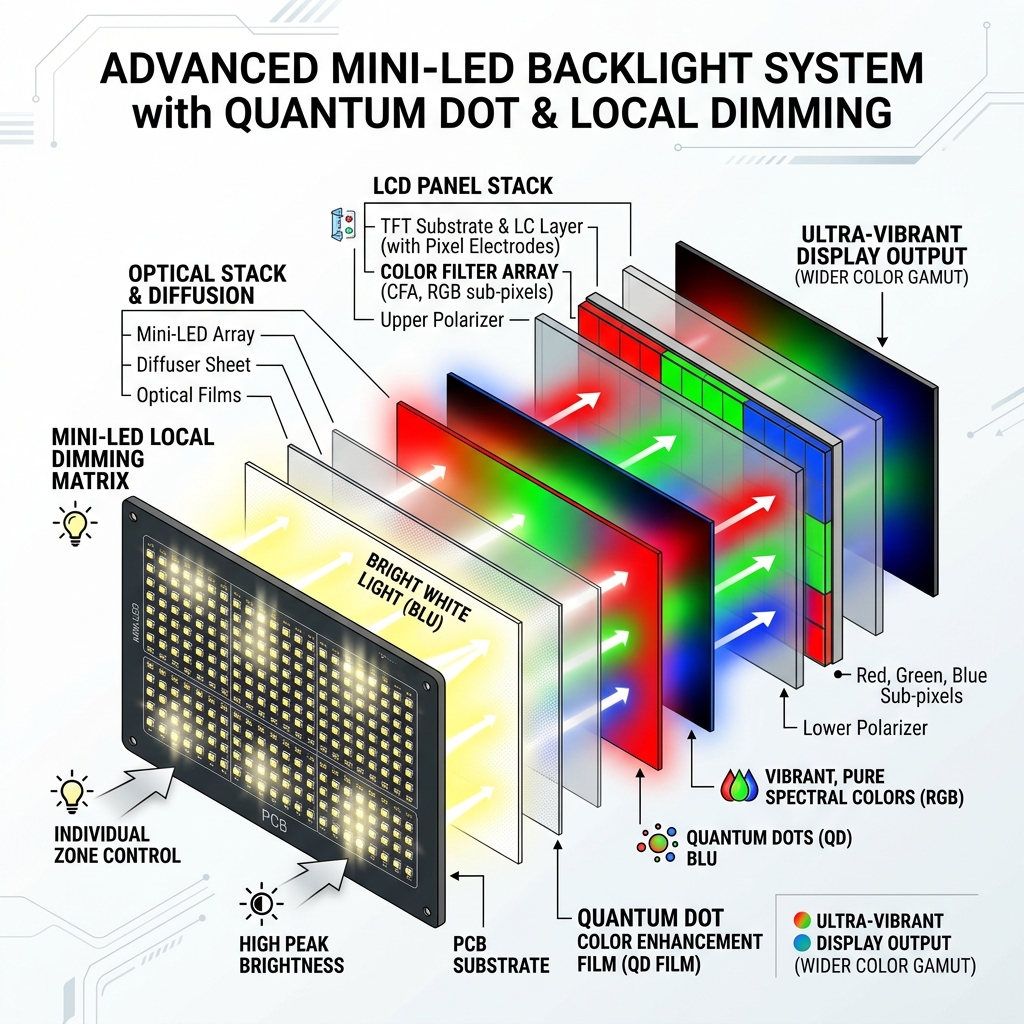
Mini-LED shrinks traditional LED backlight diodes down to a fraction of a millimeter, allowing manufacturers to pack thousands of dimming zones directly behind a QLED panel.
4. Summary Technology Matrix
| Feature | OLED | QLED | Mini-LED | Standard LED |
|---|---|---|---|---|
| Contrast Ratio | Infinite (Perfect) | Good (1,000 - 5,000:1) | Excellent (100,000:1) | Basic (800 - 3,000:1) |
| Peak Brightness | 1,000 - 1,500 Nits | 1,000 - 2,000 Nits | 2,000 - 3,500 Nits | 300 - 500 Nits |
| Viewing Angles | Ultra Wide (90°) | Moderate (45°) | Wide (60°) | Narrow (30°) |
| Best Room Placement | Dark / Cinema Rooms | Bright Sunlit Rooms | All Lighting Conditions | Budget / Everyday |